

Ask us your question
Answers to the questions you ask us most frequently
Answers to the questions you ask us most frequently
Rate the answer


General information about light
When does the new energy label come into force?
The new energy label will apply to lights from 1 September 2021.
Are there special dimmers for LEDs?
Some dimmer manufacturers now offer specialised LED dimmers. These are either leading-edge or trailing-edge dimmers with a very low minimum load range.
Is outdoor lighting harmful to (migratory) birds?
Migratory birds are mainly disturbed by light in bad weather, as they have to fly lower due to the weather conditions.
In bad weather, use dimming to reduce the brightness of your lights and do not use them at full brightness (100 per cent). Also ensure that the beam of light is not directed straight up into the sky, but is always aimed specifically at objects or the floor.
If you want to be on the safe side, avoid using your decorative outdoor lighting altogether on such days and use only functional lighting, e.g. to illuminate your paths.
Is outdoor lighting harmful to bats?
Bats use the same roosts year after year. If there are bats living in your area, you can make your outdoor lighting bat-friendly in just a few simple steps, based on the latest scientific evidence.
1. Scientists currently believe that insects are primarily attracted to light sources with a colour spectrum ranging from ultraviolet to blue and green. Warm white to orange light with colour temperatures ranging from 1,800 to a maximum of 3,000 Kelvin therefore attracts significantly fewer insects than white light. As insects form the basis of bats’ diet, warm white lighting should therefore be preferred.
2. In addition to using warm white light, the lighting should also be dimmed and not operated at full 100 per cent brightness. Trials show that dimmed light attracts up to 50 per cent fewer insects. A low illuminance (below 0.1 lx) also has an immediate positive effect on bats.
3. Surfaces and façades with exit points (openings that bats use to enter and leave their roosts) should not be illuminated. Artificial night-time lighting in front of a roost renders it less suitable and has a negative effect on the evening flight out of the roost as well as on the transfer flight.
4. Do not direct the beam of light straight up into the sky; instead, aim it specifically at objects. Directed light, confined to the immediate surroundings, is the ideal solution.
5. Do not illuminate trees. Trees (particularly tree hollows) serve as roosts for bats and should therefore not be illuminated.
6. Creating ‘islands of light’ reduces the spread of light in the surrounding area, which is disruptive to bats. A few well-lit focal points look great and ensure there are sufficient dark areas where bats can, amongst other things, hunt.
7. Only light up the garden for as long as you are actually outside. So, switch off the garden lighting when you go indoors, or use a timer switch.
Is outdoor lighting harmful to insects?
It is very easy to make outdoor lighting insect friendly. To do so, bear the following in mind:
1. Scientists currently believe that insects are primarily attracted to light sources with a colour spectrum ranging from ultraviolet to blue and green. Warm white to orange light with colour temperatures ranging from 1,800 to a maximum of 3,000 Kelvin therefore attracts significantly fewer insects than white light.
2. As well as using warm white light, it also helps with dimming the lighting rather than using it at full 100 per cent brightness. Tests show that dimmed light attracts up to 50 per cent fewer insects.
3. Insects active at night and at dusk are less strongly attracted to modern LED light bulbs than to sodium vapour or halogen light bulbs. LED lighting is therefore preferable.
4. To minimise the attraction of insects to light, it is important not to direct the beam of light straight up into the sky, but to focus it specifically on objects. Downward-facing directed light, confined to the immediate surroundings, is ideal in this respect.
5. Lighting with metal surfaces should be avoided, as these reflect the light.
6. Only light up the garden for as long as you are actually outside. So, switch off the garden lighting when you go inside, or use a timer switch.
7. Motion detectors are also suitable for (garden) paths.
Can outdoor lighting sometimes be extremely harmful and cause significant disruption to mammals?
Outdoor lighting does not necessarily have to be bad for wildlife.
The circadian system (internal clock) of mammals is particularly sensitive to the blue light spectrum. The use of artificial lighting disrupts this system at night and has a negative impact on sleep patterns. To ensure that mammals are not disturbed by night-time lighting, select warm white light ranging from 1800 to a maximum of 3000 Kelvin, rather than daylight. Trials confirm that the use of warm white light attracts 30 per cent fewer species and 40 per cent fewer individuals.
Use dimming to reduce the brightness of your outdoor lighting. The reduced brightness prevents mammals from being dazzled by the light and does not disrupt their dark adaptation as much.
And most importantly: only leave the garden lighting on for as long as you are actually outside. Switch off the garden lighting when you go inside, or use a timer switch. This is good for both your wallet and the environment.
Can the cable on pendant lights be shortened or lengthened?
With our pendant lights that have a supply cable, this can be pulled into the canopy on the ceiling and shortened to suit your needs.
As it cannot be detached from the base, it is not possible to extend it.
Can you see the light at the front of an infrared remote control?
The human eye is unable to perceive light wavelengths in the infrared area. This can be made visible in the image preview using a digital camera (excluding the Apple iPhone).
Can you request a lighting design from Paulmann?
As a manufacturer, Paulmann cannot undertake lighting design. You can find out more about indoor and outdoor lighting design in our advice sections (https://de.paulmann.com/beratung/).
For specific planning involving various lamps and lights, please contact a local electrician or lighting designer.
Can you perform LED dimming?
There are dimmable LED light bulbs that are specifically labelled as such. LED light bulbs that do not carry this label cannot be dimmed.
LED technology also enables new, modern dimming techniques that are already integrated into the light bulb, such as 3 Step Dim and EasyDim. There are also smart LED light bulbs that can be controlled via remote control, smartphone or voice command.
Can lights with touch switches also be operated using a wall switch?
Lights fitted with a touch switch cannot be operated using an external switch.
The electronics in the switch cannot directly control the flow of current without being activated.
My light won't allow dimming – what could be the reason?
The lights are generally not dimmable, or you may have selected the wrong dimming technology (leading-edge or trailing-edge dimmer). This may depend on various factors.
It may be that the selected dimming technology is not compatible with the circuit being used, e.g. a 3-step dimmable light bulb, which can only be dimmed via a standard light switch.
Please also check whether it might be a smart home product that can only be dimmed via a smart system.
Are LEDs dimmable?
There are dimmable LED light bulbs that are explicitly labelled as such. LED light bulbs that do not carry this label cannot be dimmed.
LED technology also enables new, modern dimming techniques that are already integrated into the light bulb, such as 3-step dimming and Easydimm. There are also smart LED light bulbs that can be controlled via remote control, smartphone or voice command.
Why do my LED lights and lamps flicker?
Sometimes, LED lights or lamps (but also control and regulation systems, computers, radio and television equipment; in principle, virtually any device can be affected, though the fault often goes unnoticed).
The reason for this is country-specific radio control signals transmitted by the grid and electricity suppliers at a ‘short’ transmission duration of between 110 Hz – 1.6 kHz.
The signals (transmitted only at specific times) are coded pulse sequences which are superimposed on the mains voltage via a signal voltage with amplitude modulation. The corresponding receivers in the low-voltage network interpret the signals and switch connected loads on or off. These may include various types of loads such as: peak-off-peak switching (storage heaters, heat pumps…), time synchronisation with hourly signals, street lighting, fire service signal control and similar applications.
In a single location, more systems operating at different frequencies may be in use simultaneously.
Dimmers, as well as electronic ballasts, lamp ballasts and dimmable devices, can be sensitive to the frequency pulses in the mains voltage. When a pulse occurs, the firing angle of the triac or other components shifts, which can cause flickering, etc.
Dimmers, for example, operate using phase shifters, which are surface-mounted and consist of a high-pass filter (comprising a capacitor and a variable resistor), which naturally allows the high-frequency remote control signals to pass through more easily. Consequently, the …Triac… triggers earlier than it normally would: the light becomes brighter in time with the radio control signals, which is then perceived as flickering or pulsing.
However, the signal can also cause the device to display the aforementioned message for several seconds due to longer sequences of pulses within a given time span.
In LED technology, this visible sensitivity to radio control signals is higher than in fluorescent or halogen technology.
Why do many LEDs have different brightness ratings in lumens?
With LEDs, the higher module luminous flux – which is measured on the module before the installation in the light fixture – is often quoted. After the installation in a housing and behind a lens or diffuser, the usable luminous flux is significantly lower. These values can be found on our website under the technical data for each product.
Why do some lights have none of the energy labels with ratings from A to G?
Under the current Regulation (EU) 2019/2015, light sources must be classified with an energy consumption label. So-called ‘associated products’ (lights in which the light bulb cannot be replaced) are exempt from the labelling requirement and can be found on the market without labelling.
Light bulbs with a specific application or a particularly golden-coloured light (<2200K), whose light is not classified as general lighting, are also exempt from the labelling requirement.
Why can colour variations occur between two identical LED products?
LEDs are always produced in batches. There may be variations in the light colour of the LEDs from one batch to the next; these are known as ‘binning tolerances’. If the two products come from different batches, they may appear to be two different LEDs.
The only solution is to replace them. To do this, please contact us with the proof of purchase for the products, as well as a photo showing the colour difference.
Why do LEDs in light bulbs continue to glow for a short time after being switched off?
Cables running parallel within a wall form a capacitor. Capacitors have the property of transmitting alternating voltages. The amount of energy transmitted depends on the size of the capacitor. This capacitor effect is also utilised within certain light bulbs to reduce the mains voltage.
However, capacitors formed by parallel wires in the wall only transmit extremely small amounts of energy, which are neither dangerous nor sufficient to trigger electricity meters. Due to the low energy requirements of some light bulbs, however, a faint glow may occur. The fact that this is indeed due to line capacitance can be verified by fitting a conventional lamp into the circuit. The glow will then disappear.
Even with conventional lamps, these small amounts of energy are transferred, but they are not visible due to the low resistance of the filament.
Why is it so difficult to remove the stickers from the lights?
The information on light labels is intended to ensure the light is installed correctly and operates safely; it is specified by European standards and required by European directives and national legislation.
The markings are divided into three groups:
1. Labels to be observed during the installation of the light, e.g.: F, MM, protection class, voltage.
2. Labels to be observed during the change of the lamp, e.g.: voltage, max. power, specific lamp types.
3. Markings on the protective cover that must be observed during use, e.g.: maximum distance from the illuminated surface.
In accordance with the standard, the labels must be fixed and permanently affixed to the lights and must not be removed.
Why do the LEDs emit light in different light colours even though they have the same colour temperature?
LEDs are always produced in batches. There may be slight variations in the light colour of the LEDs from one batch to the next; these are known as binning tolerances. For this reason, we recommend combining products that are as similar as possible with one another.
Why should LEDs not be operated at an ambient temperature exceeding 30°C?
LEDs should always be adequately ventilated whilst in operation to prevent overheating and the associated reduction in lifetime or failure.
It is unlikely that outdoor lights will be in operation during the day whilst exposed to direct sunlight.
Why do some LEDs take a moment to light up?
Due to component tolerances in electronic components, LED products may have different start-up times.
Start-up time is the time required to initialise the components/electronics and, consequently, the internal circuits. As a result, products may have start-up times or asynchronous start-up times of up to 2 seconds. Even a time lag in the start-up time of just a few milliseconds can be perceived (visible) (‘stroboscopic or flashing effect’).
Dimmable products require additional time, as they need to retrieve and process information from the dimmer. Dimmable products operated without a dimmer (as opposed to non-dimmable ones) have longer start-up times due to this data retrieval process. If the dimmer is set to a dimmed level at start-up, this time delay may be exacerbated. Here, too, the interaction (communication, synchronisation, etc.) between the dimmer and the LED product causes the issue. Using a different dimmer may resolve the issue, but this cannot be guaranteed. Combining different products (mixed loads) on a single dimmer may result in varying dimming behaviour.
Unfortunately, it is not possible to select between a synchronised start time or a faster load-up time. We are currently unable to offer any other solutions (state of the art).
Why do identical LED products differ in terms of light colour?
The colour temperature of white LEDs is determined using the black-body curve within the CIE colour spectrum. However, a specific light colour is not represented by a single point, but lies within a MacAdam ellipse. If different production batches vary from one another within this area, the light colour is perceived as different, even though the measured value is identical. The smaller the colour deviation during production (SDCM value as low as possible), the less noticeable the difference is to the human eye.
This can be compared to variations in building materials from different production runs, such as tiles or floor coverings.
[Image] 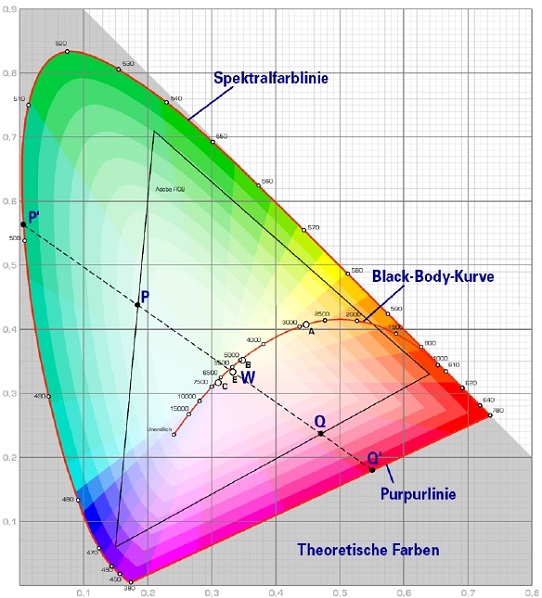
Why do sockets (e.g. Socket or Telly) burn out?
This is usually due to an installation fault. Very high currents flow in the 12V area. All connection points must therefore be fixed (and checked from time to time), as otherwise poor contact at these points will result in high contact resistance and consequently generate a great deal of heat. Tightening the screws is often forgotten when changing a bulb or adjusting the beam angle.
Why does my meter show more consumption than the power rating stated on the product’s packaging?
The measuring instrument must measure the actual active power, taking the power factor into account (excluding apparent power in the high-frequency range). The data we provide complies with the currently applicable labelling requirements.
What does ‘The light source cannot be replaced; the lights must be replaced’ mean?
The LED light bulb in this light fitting is fixed and cannot be replaced; if it fails or reaches the end of its service life, the entire light fitting must be replaced.
What does the beam angle mean?
The beam angle (°) indicates the angle at which the lamp emits light (for reflectors only). The smaller the angle, the more concentrated the beam and, consequently, the higher the candela value.
What does ‘lifetime’ mean in relation to lamps and lights?
The lifetime is the average lifespan of a light fitting. For LEDs, this is usually between 15,000 and 50,000 hours. You can find this information in the product’s technical specifications.
What does ‘energy efficiency class’ mean?
Light bulbs are also categorised into energy efficiency classes. Energy efficiency is calculated based on the light output (luminous flux, measured in lumens) per watt of power consumption. Energy efficiency class A indicates very good energy efficiency, whilst class G indicates poor energy efficiency.
What does ‘general lighting’ mean?
Basic lighting, or general lighting, provides uniform and even illumination throughout a living space. The light has none of its own direction; in other words, it illuminates the entire room without creating any specific focal points.
What does ‘power consumption’ mean?
Refers to the power drawn from the mains supply in watts (W). According to European directives, the power consumption of lamps and lights in standby mode must not exceed 0.5 W.
What does ‘light yield’ mean?
Light yield (lumens per watt) is a measure of a lamp’s cost-effectiveness. The more light (lumens) produced per unit of energy consumed (watts), the lower the costs and the greater the cost-effectiveness.
What does ‘light colour’ mean?
The term ‘light colour’ refers not only to the actual colour in the RGB colour space, but also to the colour temperature of white LEDs.
A distinction is made here between warm-white and cool-white light, and the temperature is expressed in Kelvin (K).
The higher this value, the greater the proportion of blue, and the light appears ‘colder’. If the colour temperature is lower, the proportion of red increases and the light becomes ‘warmer’.[Image] 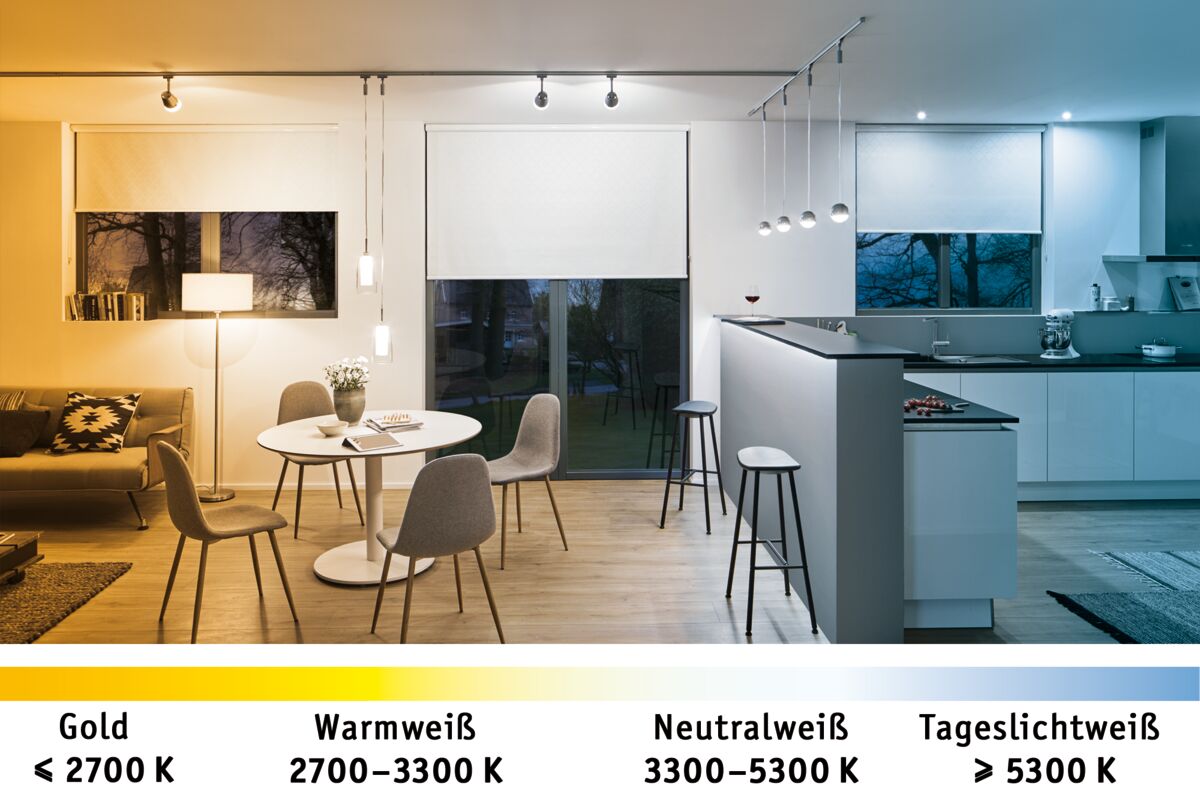
What does ‘light output’ mean?
Luminous efficacy defines the radiant power emitted by a light bulb in the visible wavelength range (380 nm to 780 nm). This radiant power is weighted according to the spectral sensitivity of the human eye.
What does ‘luminous intensity’ mean?
Luminous intensity is the luminous flux emitted by a lamp in a specific direction. Luminous intensity is measured in candelas (cd). This is important for reflector lamps, which focus the light. The smaller the beam angle, the more concentrated the light and the greater the luminous intensity.
What does ‘lumen’ (lm) mean?
Lumen measures the brightness of a light fitting. The lumen value indicates the actual amount of light emitted by a lamp.
What does lux (lx) mean?
Lux (lx) is the unit of measurement for illuminance. A point light source with a luminous intensity of X candelas produces exactly X lux on a vertically illuminated surface at a distance of 1 metre.
In short: 1 lux (lx) is equivalent to one lumen (lm) per square metre of illuminated surface.
What do RGB and RGBW stand for?
Depending on the light fitting, up to 2 million different adjustable colours can be produced from the colours red (R), green (G) and blue (B), and a continuous colour change is also possible. With RGBW, a white (W) LED is added.
What does SDCM stand for?
SDCM stands for ‘Standard Deviation of Colour Matching’ and describes the possible variation in colour consistency. The light colour of an LED is specified in Kelvin (K) and ranges from golden (less than 2700K) through warm white (2700K–3300K) and neutral white (3300K–5300K) to daylight white (greater than 5300K). During production, deviations can occur even in identical items; these are represented by ellipses of varying sizes according to the MacAdam system, centred on the measurement point on the black-body curve. The greater the deviation, the more different the light appears. For this reason, the colour rendering is better when the SDCM value is as low as possible. At SDCM 1, the human eye cannot perceive any difference; the EU stipulates a maximum SDCM value of 6 for LED products.
What sort of switch is required for 3 Step Dim lights and lamps?
To operate lights and lamps with 3 Step Dim technology, a standard two-way or on/off switch is required. A push-button switch with relay control may adversely affect performance due to the delay.
What is accent lighting?
Accent lighting refers to the practice of directing the light from the lights used towards one or more objects in a room. This creates focal points on the one hand and produces stronger contrasts on the other. Narrow-beam lights, such as recessed or surface-mounted ceiling lights, are used for accent lighting. Point light sources are suitable for this purpose. The lights should be individually adjustable, as the location of objects in the room is usually variable.
What is general lighting?
General lighting, or basic lighting, refers to the uniform and even illumination of a living space. The light has none of its own direction; in other words, it illuminates the entire room without creating any specific focal points.
What should you bear in mind when selecting dimmers?
In an installation, the correct dimmer must be matched to the correct lamp or light. All Paulmann transformers (230/12V AC) are dimmable.
- For LED light bulbs, you need either a leading-edge or trailing-edge dimmer.
- For 12V AC with an electronic transformer, you need a trailing-edge dimmer; for 12V DC with a conventional transformer, you need a leading-edge dimmer.
- You can dim 230V LED lights with any dimmer.
Three letters – ‘R’, ‘L’, ‘C’ – or combinations thereof identify dimmers and electronic transformers. To select the correct dimmer, the corresponding letters on the transformer, the lamp and the dimmer must match.
What is the beam angle?
The beam angle (°) indicates the angle at which the lamp emits light (applies to reflectors only). The smaller the angle, the more concentrated the beam and, consequently, the higher the candela value. The candela (cd) is the unit of measurement for luminous intensity (luminous flux per solid angle).
What is the colour rendering index (Ra)?
The colour rendering index (Ra) indicates how naturally colours are rendered under a given light source. The maximum value that can be achieved is 100.
What is the difference between warm white and cool white light?
The lower the Kelvin value, the greater the proportion of red and the warmer the light appears. If the Kelvin value increases, the proportion of blue increases and the light appears cooler. More information can be found via the link (https://de.paulmann.com/beratung/lichtlexikon/farbtemperatur/).
What is the CE marking?
The CE marking certifies compliance with the essential requirements of certain European Union directives. The CE marking is affixed to the lights, their packaging or the accompanying documentation by the manufacturer or importer, on their own responsibility.
What is a damp-proof light fitting?
The term ‘damp-proof lights’ generally refers to lights with a higher degree of protection, which, by virtue of their design, are protected against the ingress of moisture into the interior of the light (at least IP44). As the term ‘damp-proof light’ is non-specific, the degree of protection is specified for each light. The protection rating indicates the level of protection against the ingress of, for example, moisture, which is high.
What should you bear in mind when installing lighting in the bathroom?
In the bathroom, the correct protection class for lamps and lights must be selected in accordance with DIN VDE 0100 T.701. Due to country-specific regulations, a qualified electrician should be consulted.
What are COB LEDs?
The term COB stands for ‘chip-on-board’ and refers to the technology of placing several LED chips directly onto an aluminium circuit board. This high density produces high brightness with uniform and seamless lighting.
What are LEDs?
LEDs are light-emitting diodes – the abbreviation stands for ‘Light Emitting Diode’. These electronic semiconductor components convert significantly more energy into light than into heat. Compared with conventional incandescent bulbs, this makes them extremely economical and environmentally friendly.
What are orientation lights?
Lights that are not intended for general lighting but rather to aid orientation, for example through the use of light points or strips.
What are SMD LEDs?
The term SMD stands for ‘surface-mounted device’, where LEDs are mounted directly onto the printed circuit boards without any additional wire connections.
What colour temperatures are there for white light?
The light colour of a lamp is referred to as its colour temperature. The unit of measurement for colour temperature is the kelvin (K). Colour temperatures up to 3,300 K are described as warm white, those from 3,300 K to 5,300 K as neutral white, and those above 5,300 K as daylight white.
Which lights or lamps are dimmable?
You can dim LED lamps and LED lights if they are specifically designed and labelled for this purpose. There are also dimming technologies that are built into the light bulb – these include, for example, ZigBee, Bluetooth, 3-step dimming and Easydimm.
What protection classes are there?
Classification of protection against electric shock. There are protection classes I, II and III.
Protection class I features an earth connection (cable marking: green-yellow). The double insulation of protection class II is used, for example, in conjunction with Euro plugs without an earth connection. Protection class III refers to devices operated at safety extra-low voltage.
Which dimmer is recommended for Paulmann lights?
As universal dimmers, we recommend the following dimming actuators, which are used in conjunction with a push-button switch:
Müller PALADIN 87030
Vadsbo LD220
Do LEDs get hot?
LED lamps also get hot when in use. Whilst incandescent lamps convert 90–95 per cent of their power consumption into heat, LEDs convert only 70–80 per cent. LED lamps can generate enough heat to cause pain if touched with bare hands. High-performance LED chips can reach temperatures of up to 120 degrees after a period of operation.
It is therefore important that the installation requirements are met: cavity depth, installation depth, a continuous cavity in suspended ceilings, and no insulation material or cables must rest on top of them.
How does the push-dimm function work?
With push-dimming, a push-button is wired to the appropriate dimmer via a control line. This allows the light to be switched on and off and dimmed continuously. This is usually achieved via a bus system such as KNX or DALI, using a voltage of between 1 and 10 V.
How does the White Switch function work?
On our lights fitted with the White Switch, the white colour can be adjusted by pressing the wall-mounted or integrated sensor switch several times. This switches the light between warm white (2700K), neutral white (4000K) and daylight white (6500K).
If the light is switched off for a length of time, the System remembers the last colour setting.
How much electromagnetic pollution do Paulmann lights cause?
Electrical products always generate electric and magnetic fields. The maximum permissible intensity is regulated by the relevant EU directives and the applicable standards on electromagnetic fields.
Paulmann products comply with these requirements.
How bright are LED lights with non-replaceable light bulbs?
This information can be found in the technical specifications for the light (lumens).
How does Paulmann help with lighting design?
As a manufacturer, Paulmann is currently unable to undertake lighting design. We’re happy to assist you with product enquiries or coordinating systems that have already been planned.
You can find out more about lighting design for indoor and outdoor areas in our advice sections (https://de.paulmann.com/beratung/). For specific planning of various lamps and lights, please contact a local electrician or lighting designer.
What is the light distribution curve of the 3 Step Dim gu10 reflector (item no. 28577)?
[Image] 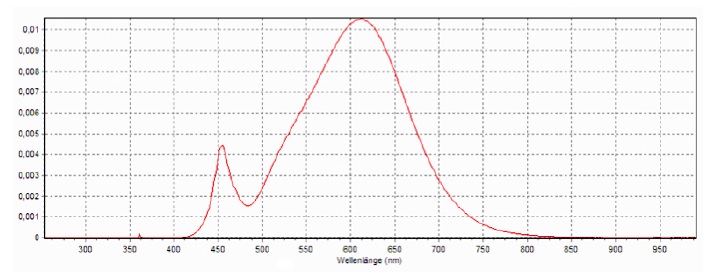
What is the light distribution curve of the Easy Dim gu10 reflector (item no. 28798)?
[Image] 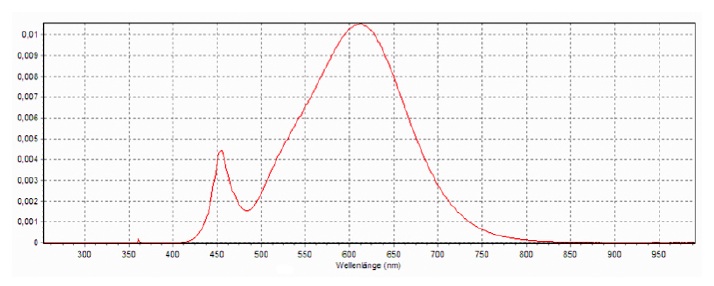
How much power do the lamps and lights use in standby mode?
Every Paulmann lamp or light complies with the current EU energy standards and has a power consumption of less than 0.5W.
How many lights should be fitted in a room?
The following approximate figures can be used to calculate basic lighting requirements in the home:
Living areas and hallways: approx. 100 lumens per square metre; kitchen and bathroom: approx. 300 lumens per square metre
The key factor here is the rated or effective luminous flux, which can be found on the packaging and in the technical specifications online.
More information and tips on lighting can be found on our website.
An electrician or lighting designer on site can assist with more detailed planning.
Does artificial lighting have a negative effect on the formation of flowers and leaves on trees?
Plants respond to four parameters of ambient light: the quality of the light spectrum, light intensity, light direction and duration of light exposure. A small number of experiments show that, under continuous light (24 hours), photosynthetic capacity declines in some species, whilst in others it triggers flower formation.
However, there has so far been a lack of research into the effect of the length of light exposure caused by artificial night-time lighting on plants in their natural environment.
Does artificial lighting have a negative effect on plant pollination?
Artificial lighting can, under certain circumstances, influence the development of plants. An experiment in Switzerland shows that some plant species, such as thistles, are visited less frequently by pollinating insects within the light beam of a lamp and may consequently produce up to 20 per cent fewer seeds. To avoid disrupting the pollination of plants by nocturnal insects, we recommend designing outdoor lighting to be insect friendly. To this end, the following should be taken into account:
1. Scientists currently believe that insects are primarily attracted to light sources with a colour spectrum ranging from ultraviolet to blue and green. Warm white to orange light with colour temperatures ranging from 1,800 to a maximum of 3,000 Kelvin therefore attracts significantly fewer insects than white light.
2. As well as using warm white light, it also helps with dimming the lighting rather than using it at full 100 per cent brightness. Trials show that dimmed light attracts up to 50 per cent fewer insects.
3. Insects active at night and at dusk are less strongly attracted to modern LED light bulbs than to sodium vapour or halogen light bulbs. LED lighting is therefore preferable.
4. To minimise the number of insects attracted by light, it is important not to direct the light beam straight up into the sky, but to aim it specifically at objects. Downward-facing directed light, confined to the immediate surroundings, is the ideal solution.
5. Lighting with metal surfaces should be avoided, as these reflect the light.
6. Only light up the garden for as long as you are actually outside. So, switch off the garden lighting when you go indoors, or use a timer switch.
7. Motion detectors are also suitable for (garden) paths.
Where can I find the EPREL data for Paulmann light bulbs?
The data can be viewed directly in the EU database via the following link:
https://eprel.ec.europa.eu/screen/product/lightsources
Why is IP-protection needed?
IP-protection is particularly important in damp conditions, whether indoors or outdoors. You can find out which protection class you need here (https://de.paulmann.com/beratung/lichtlexikon/ip-schutz/).
How can you tell if a light or lamp is dimmable?
In the online shop, dimmability is indicated by the dimmer symbol. Information on dimmability can also be found in the product details or under the ‘Technical Specifications’ tab.
In Paulmann catalogues or on packaging, you can also recognise dimmable Paulmann lamps and lights by the dimming symbol.